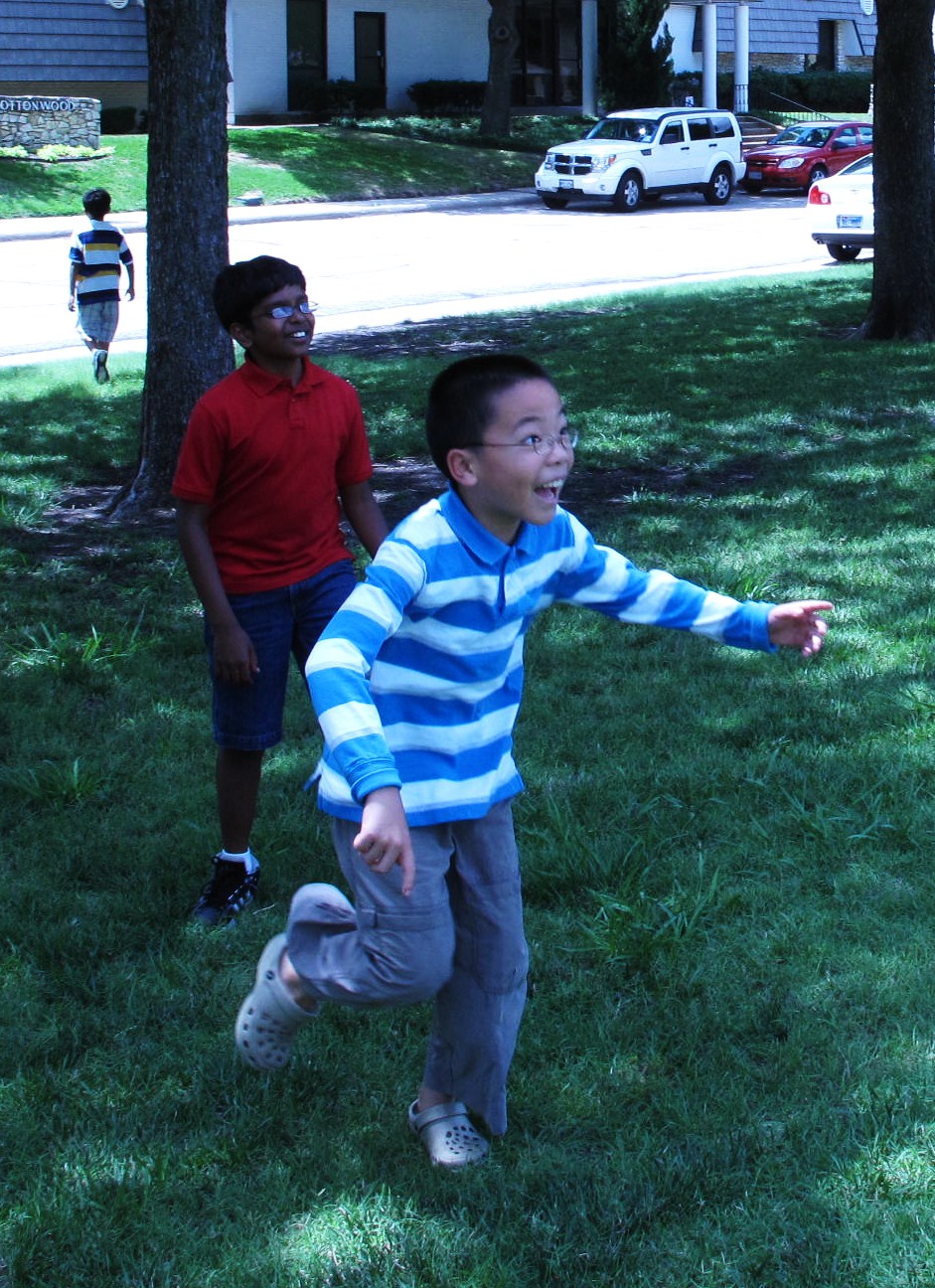
teachers:
IM Greg Shahade
FM Aviv Fridman
students:
Justus Williams: 2154, 11 years old
James Black: 2119, 11 years old
Jeffery Xiong: 2108, 9 years old
Sarah Chiang: 2106, 13 years old
Dachey Lin: 2103, 10 years old
Jeevan Karamsetty: 2050, 12 years old
Mika Brattain: 2024, 11 years old
Li Ruifeng: 1985, 8 years old
Jonathan Chiang: 1913, 10 years old
Tanuj Vasudeva: 1927, 9 years old
Wednesday, July 7, 2010


Tuesday, July 6, 2010
Jonathan cannot hold his milk
 At the beginning, Jonathan holds the gallon of fresh skim milk confidently.
 The eyes of a winner.

after 30 minutes and half a gallon, the tide begins to turn: "I feel like I'm sweating inside my body"
 Jonathan has 10 minutes and four glasses of milk left. He tries valiantly but does not make it. The later photos are too awful to post.
I arrived tonight in Dallas with Justus and James for the US Chess School. They were foolish enough to bet me they could eat 6 saltines in a minute. They compounded their poor judgment by accepting a double or nothing challenge (for some reason they thought crushing the saltines in your hand before putting them in your mouth would help) and they now owe me 100 tactics problems each and a public admission of my greatness.
Monday, July 5, 2010
coming tomorrow: JONATHAN ATTEMPTS THE MILK CHALLENGE
 Jonathan has foolishly bet me he can drink a gallon of milk in an hour. He clearly has not learned anything from his ignominious defeat at the Saltine Challenge. I will be taking pictures (for you) and laughing my ass off.
Saturday, July 3, 2010
I'm almost 35!
I will be at the US Chess School in Dallas on my birthday (July 8), so Jonathan made me birthday dinner on Friday.
 tempeh pineapple kebabs with asian coleslaw!
 lemon blueberry cream pie!
 Jonathan with Silly Party Decorations and Coffee
 me, with streamers
I didn't want to play in the World Open this year, because it's in King of Prussia, and because it sucks being inside, around weirdos, concentrating all day in the summertime, but now that I'm not, I'm jealous of everyone who is.
 tempeh pineapple kebabs with asian coleslaw!
 lemon blueberry cream pie!
all of it is vegan!
 Jonathan with Silly Party Decorations and Coffee
 me, with streamers
I didn't want to play in the World Open this year, because it's in King of Prussia, and because it sucks being inside, around weirdos, concentrating all day in the summertime, but now that I'm not, I'm jealous of everyone who is.
Wednesday, June 30, 2010
I begin my CLEP odyssey!
Today I took the first three of 8 or 10 CLEP (College Level Examination Program) tests. It's like being on a moderately difficult game show where you only have to get 50% to win and you choose the categories. When I have passed thirty hours worth (most tests are 3 credits, some are 6), I move up a "salary step" and make $7,000/year more. (isn't that fantastic!!??) These are the tests:
Composition and Literature
* American Literature
* Analyzing and Interpreting Literature
* College Composition and College Composition Modular
* English Composition
* English Literature
* Freshman College Composition
* Humanities
Foreign Languages
* French Language (Levels 1 and 2)
* German Language (Levels 1 and 2)
* Spanish Language (Levels 1 and 2)
History and Social Sciences
* American Government
* Human Growth and Development
* Introduction to Educational Psychology
* Introductory Psychology
* Introductory Sociology
* Principles of Macroeconomics
* Principles of Microeconomics
* Social Sciences and History
* History of the United States I: Early Colonization to 1877
* History of the United States II: 1865 to the Present
* Western Civilization I: Ancient Near East to 1648
* Western Civilization II: 1648 to the Present
Science and Mathematics
* Biology
* Calculus
* Chemistry
* College Algebra
* College Mathematics
* Natural Sciences
* Precalculus
Business
* Financial Accounting
* Introductory Business Law
* Information Systems and Computer Applications
* Principles of Management
* Principles of Marketing
They are scored 20 to 80 and you need 50 to pass. You can't get credit for the exact same class you took in college. I took American Government (score = 63), History of the United States 1865-present (score=63) and College Algebra (score=77, even though I forgot how to do logs).
B: House of Representatives
C: Supreme Court
D: Cabinet
E: Department of Defense
1. D. Revenue-sharing grants are basically dispersals of federal funds to local officials.
2. C. In the wake of the American Revolution, citizens were unwilling to allow a strong central authority.
3. D. A caucus is a closed meeting in which the members of a political party select a representative.
4. E. A caucus is a closed meeting in which the members of a political party select a representative.
5. B. A writ of certiorari is a higher court's request of a trial transcript.
6. B. The districts represented by the House of Representatives are meant to be equal in population.
US History 1865-present
B: an emphasis on energy conservation and price controls
C: an embargo against Saudi Arabia
D: a massive shutdown of industry
E: a filibuster on the floor of the Senate
1. C. In Pollock v. Farmer's Loan (1895), the Supreme Court had ruled the federal income tax unconstitutional.
2. D. During this period, the agenda of the United States was to protect its economic interests and expand its influence.
3. A. After establishing extremely strict voting requirements, states declared that individuals whose relatives had voted before 1867 could automatically vote.
4. E. Father (Charles) Coughlin was one of the more popular right-wing speakers during the 1930s.
5. E. In contrast to W.E.B. DuBois, Washington advocated working for equal rights within the preexisting system.
6. B. The 1973 oil crisis began when the OPEC nations declared they would no longer trade with nations that had supported Israel during the Yom Kippur War.
College Algebra


1. A. Isolate the values for y and y2, and determine the values that make the equation true for these variables.
2. C. This problem can be solved in reverse by mentally applying FOIL to the answer choices.
3. B. Distribute the 8 across the parentheses before moving on.
4. D. Determine the value for P and factor in the given subscripts.
5. E. This problem can be simplified to 11 x 4 = 44.
6. D. X-intercepts are the places where the parabola passes through the x-axis.
7. A. This problem can be solved in reverse by mentally applying FOIL to the answer choices.
I take three more on Friday. I'm thinking Macroeconomics, College Mathematics, and maybe Social Sciences and History (it's 6 credits, I'm just not sure what it is). :) Incidentally, I have no idea what question four in the math above is talking about.
Composition and Literature
* American Literature
* Analyzing and Interpreting Literature
* College Composition and College Composition Modular
* English Composition
* English Literature
* Freshman College Composition
* Humanities
Foreign Languages
* French Language (Levels 1 and 2)
* German Language (Levels 1 and 2)
* Spanish Language (Levels 1 and 2)
History and Social Sciences
* American Government
* Human Growth and Development
* Introduction to Educational Psychology
* Introductory Psychology
* Introductory Sociology
* Principles of Macroeconomics
* Principles of Microeconomics
* Social Sciences and History
* History of the United States I: Early Colonization to 1877
* History of the United States II: 1865 to the Present
* Western Civilization I: Ancient Near East to 1648
* Western Civilization II: 1648 to the Present
Science and Mathematics
* Biology
* Calculus
* Chemistry
* College Algebra
* College Mathematics
* Natural Sciences
* Precalculus
Business
* Financial Accounting
* Introductory Business Law
* Information Systems and Computer Applications
* Principles of Management
* Principles of Marketing
They are scored 20 to 80 and you need 50 to pass. You can't get credit for the exact same class you took in college. I took American Government (score = 63), History of the United States 1865-present (score=63) and College Algebra (score=77, even though I forgot how to do logs).
CLEP American Government Practice Questions
US Government
1. What is the name of the type of federal grant that gives wide discretion to local officials?
A: fund grant
B: block grant
C: mandated grant
D: revenue-sharing grant
E: categorical grants
2. Whose power is the Bill of Rights intended to restrict?
A: the citizens
B: the President
C: the federal government
D: the Senate
E: the House of Representatives
3. Which amendment to the Constitution specifically outlines the powers delegated to the states?
A: Seventh
B: Eighth
C: Ninth
D: Tenth
E: Eleventh
4. How did political parties nominate presidential candidates until the early nineteenth century?
A: direct election
B: series of state primaries
C: selection by party chairman
D: lottery
E: congressional caucuses
5. Who is responsible for issuing a writ of certiorari?
A: Congress
B: Supreme Court
C: Attorney General
D: President
E: Chief Justice of the Supreme Court
6. According to the Constitution, the members of which body must be chosen by popular election?
A: SenateB: House of Representatives
C: Supreme Court
D: Cabinet
E: Department of Defense
1. D. Revenue-sharing grants are basically dispersals of federal funds to local officials.
2. C. In the wake of the American Revolution, citizens were unwilling to allow a strong central authority.
3. D. A caucus is a closed meeting in which the members of a political party select a representative.
4. E. A caucus is a closed meeting in which the members of a political party select a representative.
5. B. A writ of certiorari is a higher court's request of a trial transcript.
6. B. The districts represented by the House of Representatives are meant to be equal in population.
US History 1865-present
1. What did the Sixteenth Amendment establish?
A: women's suffrage
B: the Department of Education
C: income tax
D: prohibition
E: direct election of senators
2. Which of the following words characterizes American foreign policy between 1901 and 1920?
A: schizophrenic
B: isolationist
C: apathetic
D: nationalistic
E: disjointed
3. What was the intention of the grandfather clause issued in the 1890s?
A: To prevent non-whites from voting
B: To reduce the voting age to 18
C: To provide health care to senior citizens
D: To avoid conflict between blacks and whites
E: To restrict Native Americans to the reservations.
4. Why were the radio broadcasts of Father Coughlin controversial?
A: They called Franklin Roosevelt a socialist.
B: They were broadcast from Nazi Germany.
C: They used obscene language.
D: They advocated socialism.
E: They were often anti-Semitic.
5. Which of the following statements best expresses the philosophy of Booker T. Washington?
A: African-Americans should acquire their rights by force if necessary.
B: African-Americans should wait and allow rights to be granted them over time.
C: African-Americans do not deserve equal rights.
D: African-Americans should form their own nation in the western United States.
E: African-Americans should help themselves rather than looking for help from others.
6. What was the Democratic response to the oil shortages of the 1970s?
A: an invasion of IranB: an emphasis on energy conservation and price controls
C: an embargo against Saudi Arabia
D: a massive shutdown of industry
E: a filibuster on the floor of the Senate
1. C. In Pollock v. Farmer's Loan (1895), the Supreme Court had ruled the federal income tax unconstitutional.
2. D. During this period, the agenda of the United States was to protect its economic interests and expand its influence.
3. A. After establishing extremely strict voting requirements, states declared that individuals whose relatives had voted before 1867 could automatically vote.
4. E. Father (Charles) Coughlin was one of the more popular right-wing speakers during the 1930s.
5. E. In contrast to W.E.B. DuBois, Washington advocated working for equal rights within the preexisting system.
6. B. The 1973 oil crisis began when the OPEC nations declared they would no longer trade with nations that had supported Israel during the Yom Kippur War.
College Algebra
1. A. Isolate the values for y and y2, and determine the values that make the equation true for these variables.
2. C. This problem can be solved in reverse by mentally applying FOIL to the answer choices.
3. B. Distribute the 8 across the parentheses before moving on.
4. D. Determine the value for P and factor in the given subscripts.
5. E. This problem can be simplified to 11 x 4 = 44.
6. D. X-intercepts are the places where the parabola passes through the x-axis.
7. A. This problem can be solved in reverse by mentally applying FOIL to the answer choices.
I take three more on Friday. I'm thinking Macroeconomics, College Mathematics, and maybe Social Sciences and History (it's 6 credits, I'm just not sure what it is). :) Incidentally, I have no idea what question four in the math above is talking about.
Tuesday, June 29, 2010
my luck continues
 In the above position (round 3 of the Marshall G/60) my opponent, Glenn Leotaud (1833) played 17...h6. How do I win?

18. Rxd7! Qxd7
19. Rxd7 Nxd7
20. Be3 f6
21. Bxc5 Nxc5
22. Qc4+ Rf7
23. b4 Nd7
24. Bh3 Rc8
25. Qd3 Kf8
26. Nh4
1-0
I make a lot of horrible mistakes, but get lucky in the end
Karl Escherbach - Elizabeth Vicary
marshall g/60, rd 2
1. e4 c6
2. Nc3 d5
3. d4 dxe4
4. Nxe4 Bf5
5. Ng3 Bg6
6. N1e2 Nd7
7. Nf4

7...e5! I liked this move.
8. Nxg6 hxg6
9. Bc4
 how does black win a pawn here?
 picture of a pretty tree to cover the answer!
with 9...Nb6! 10. Bb3 Qxd4. of course I don't even look at it and instead play
9... exd4 This is stupid and just develops white's queen for him. I'm happy if white takes on e5-- it centralizes my knight, so I should just develop something. or play Nb6.
10. Qxd4 Rh4
11. Qe3+ Be7
12. Bb3 Ngf6
 what should black not do?
 me at elementary nationals, covering the answer
Black should not play 13...Rxh2. What happened was this: I thought about it for a while, and I became scared of the line 13...Rxh2 14. Re1 (threatening 15. Qxe7 Qxe7 16. Rxe7 Kxe7 17. Kxh2) 14...Rh4/8, and then Bd2, Rad1, Bc3 maybe, and it's not so easy for black to find a safe place for the king, even defending e7 can get tricky, and so I thought maybe I can't spend the tempi to take this pawn, then my mind wandered for a bit, just kind of idly touching on a few alternatives, but not finding anything concrete, and then felt annoyed with myself and told myself to stop wasting time and make a decision. I decided to just play Rxh2, then Rh4, then Kf8: how bad can it be?
13...Rxh2??
14. Re1?? (amazingly, he also overlooked 14. Bxf7+! Kxf7 15.Qb3+ Nd5 16. Kxh2)
14... Rh4
15. Bd2 Kf8
16. Rad1 Bc5
17. Qf3 Qc7
18. Bg5
 18....Rg4?
I completely miss how strong his next move is.
19. Ne4! Ne5
And also his next move. I wasn't so much analyzing here, as looking at candidate moves and randomly picking one.
20. Qh3 20...Bxf2+ I realized I was lost here, so I was trying to play the most complicated moves.
21. Kxf2 Nxe4+
22. Rxe4 Rxg5
23. Qh8+ Ke7
24. Qxa8 Qb6+
 White has six ways to get out of check. three of them lose. pretty much 50-50 who wins I guess.
25. Kf1 Rf5+
0-1
hahahahaa. poor dude. guess what he said to me afterwards?
"I just thought you were going to resign."
marshall g/60, rd 2
1. e4 c6
2. Nc3 d5
3. d4 dxe4
4. Nxe4 Bf5
5. Ng3 Bg6
6. N1e2 Nd7
7. Nf4

7...e5! I liked this move.
8. Nxg6 hxg6
9. Bc4
 how does black win a pawn here?
 picture of a pretty tree to cover the answer!
with 9...Nb6! 10. Bb3 Qxd4. of course I don't even look at it and instead play
9... exd4 This is stupid and just develops white's queen for him. I'm happy if white takes on e5-- it centralizes my knight, so I should just develop something. or play Nb6.
10. Qxd4 Rh4
11. Qe3+ Be7
12. Bb3 Ngf6
13. O-O
 what should black not do?
 me at elementary nationals, covering the answer
Black should not play 13...Rxh2. What happened was this: I thought about it for a while, and I became scared of the line 13...Rxh2 14. Re1 (threatening 15. Qxe7 Qxe7 16. Rxe7 Kxe7 17. Kxh2) 14...Rh4/8, and then Bd2, Rad1, Bc3 maybe, and it's not so easy for black to find a safe place for the king, even defending e7 can get tricky, and so I thought maybe I can't spend the tempi to take this pawn, then my mind wandered for a bit, just kind of idly touching on a few alternatives, but not finding anything concrete, and then felt annoyed with myself and told myself to stop wasting time and make a decision. I decided to just play Rxh2, then Rh4, then Kf8: how bad can it be?
13...Rxh2??
14. Re1?? (amazingly, he also overlooked 14. Bxf7+! Kxf7 15.Qb3+ Nd5 16. Kxh2)
14... Rh4
15. Bd2 Kf8
16. Rad1 Bc5
17. Qf3 Qc7
18. Bg5
 18....Rg4?
I completely miss how strong his next move is.
19. Ne4! Ne5
And also his next move. I wasn't so much analyzing here, as looking at candidate moves and randomly picking one.
20. Qh3
 20...Bxf2+ I realized I was lost here, so I was trying to play the most complicated moves.
21. Kxf2 Nxe4+
22. Rxe4 Rxg5
23. Qh8+ Ke7
24. Qxa8 Qb6+
 White has six ways to get out of check. three of them lose. pretty much 50-50 who wins I guess.
25. Kf1 Rf5+
0-1
hahahahaa. poor dude. guess what he said to me afterwards?
"I just thought you were going to resign."
I win a chess tournament!
 some kids in my neighborhood
On Saturday I played in the G/60 at the Marshall and (SURPRISE!!) I won it! Not very many people showed up: a lot of strong kids were at the NY State Junior Open (Justus Williams tied for first!) and some people are probably in Philadelphia for the Philadelphia Open. I don't know where Asa Hoffman was, usually he lurks around, waiting for moments like these.
There were 10-14 players, depending on how/when you count(ed). I was second seed, number one was Michael Thaler, who just graduated from Hunter and is going to Brown next year. Michael's first round game was an e6 Sicilian against David Siudzinski, who, uncoincidentally, was also my fourth round opponent. David played a Keres attack, and the position quickly became one of those sharp but super-positional ones, where there are tons of weak squares, knight outposts on e5, pawn breaks, etc., and you have to figure out which one's the most important. It's fun to watch strong players beat weak players in those positions, because the losers end up looking like hopeless bumblers. David seemed like he was playing reasonably, I wasn't watching that closely for obvious reasons, but I thought Michael was clearly winning when my game finished. I had 40 minutes until round two, so I went to Zara and bought a cardigan (board two was directly under the air conditioner). I came back to hear Thaler drew and withdrew in disgust.
Another expert joined, but he had taken a half point bye in round one, drew round two, and lost to my esteemed fourth round opponent in round three. Other than this very talented 1600, it was just A players to beat, and I managed.
Vicary, Elizabeth --Seldon, Alex Evan
1. d4 d5
2. c4 c6
3. Qc2
 I've been teaching this to a few kids, and I got interested enough to start playing it myself. This is my first game in the line. I learned it from Jonathan Hilton and Dean Ippolito's excellent book "Wojo's Weapons." It's fun to play because no one has any idea what to do against it. The two big ideas are to take on c4 and play Bf5 (against which white plays Qxc4, Nf3, g3, Bg2, 0-0, e3, Qe2, Nc3 and e4) and or to play g6 and Bf5 (against which white plays Qb3, Qb6; c5 Qxb3; axb3 and b4-b5).
3...Nf6
4. Nf3 g6
5. Bf4 Bg7
6. e3 O-O
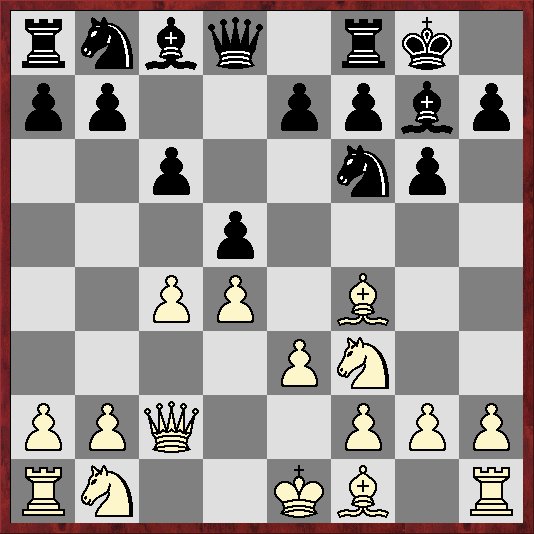 7. Bd3 I don't know why I didn't play Nc3 here. I wasn't really sure if my bishop belonged on d3 or e2, and usually that would prompt me to delay deciding and develop the knight instead, but somehow it didn't. I think I was just used to Catalan-y play where you take care of the kingside first.
Also, I was really confused why he wasn't playing Bf5.
7...Nbd7
8. h3 Nb6
9. c5 Nbd7
10. O-O Re8
11. Nc3
 So I was expecting 11... Nh5 12. Bh2 e5 here, when I have to take: 13. dxe5 Nxe5 14. Nxe5 Bxe5 15. Bxe5 Rxe5 and it's dangerous for me after 16. Ne2 Qh4, when black is threatening 17.. Bxh3 right away.
11...b6
12. b4 This is the normal response to b6, defending my c pawn, but it happens in this position that I can take: 12. cxb6! Now if they recapture with the queen or knight, I'm happy because the c pawn is backwards and play Rfc1 or Na4 or Ne5 or moves like that. Black wants to recapture with the a pawn, then later to play ...c5, but 12... axb6 runs into the brilliant 13. Nb5!, which threatens both Nc7 and Bc7.
12... Bb7
He can't really play 12... a5 because I have 13. b5! and 13... cxb5 14. c6! or 13...bxc5 14. bxc6 Nf8 15. c7 Qd7 16. Bb5.
Interestingly, 12... Nh5 13. Bh2 e5 is not quite as good as before, because after 14. dxe5 Nxe5 15. Nxe5 Bxe5 16. Bxe5 Rxe5 17. Ne2 Qh4, black's queenside is loose(r) after 18. cxb6:
 (analysis diagram. Bxh3: still frightening)
13. Bh2 Maybe kinda pointless as I can't really stop e5 if he wants to play it?!
13... a5
14. a3 Qc8
 Here I figured it must be time to take on b6 and attack c6.
15. cxb6 Nxb6
16. Ne2 Nfd7
17. Rfc1 e5 He gets his break in, but he's done too much damage to his pawn structure.
18. dxe5 Nxe5
19. Nxe5 Bxe5
20. Bxe5 Rxe5
21. Nd4

21...axb4
22.axb4 Rxa1
23. Rxa1 Nd7
24. Rc1 Nb8

25. b5! Re7
26. bxc6 Ba8
27. Qa4 Nd7 (27...Bb7!)
28. cxd7 (28. Qa3 is even better)
28... Qxc1+
29. Bf1 Rxe3
30. Qxa8+ Kg7
31. d8=Q Re1
32.Qf8+ 1-0
here's a nice story on two chess shops in NY.
 also, my sister dyed my hair bright red. think it's summery looking?
how many times does she shoot her gun in the 43 second commercial?
seven!
thanks to Ray Cheng for the link. original is here if you can't see the whole screen. also from Ray and also great: "Get Away From That"
Justus in the Wall Street Journal
Portrait of a Bronx Chess Champion, Age 12
 When Bronx student Justus Williams started third grade at P.S. 70, his mother, Latisha, urged him to take on chess. The hobby was “less common” than basketball, she said.
But Justus wasn’t enthusiastic at first. “I thought I was going to be embarrassed,” he said.
As it turned out, mom knew best.
Justus, now 12 and completing sixth grade, is the highest-rated chess player in the U.S. in his age and gender group, and fourth overall in World Chess Federation international rankings for his age group.
full article here
Subscribe to:
Posts (Atom)